Korean Cuisine Sketch Hand Drawn Vector Set
First Impression: Charm with Clear Intent
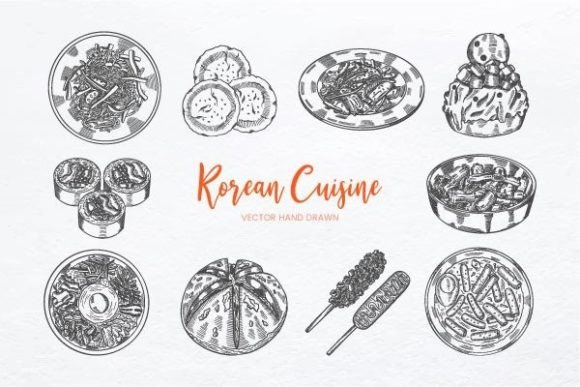
Opening the Korean Cuisine Sketch Hand Drawn Vector Set feels like flipping through a chef’s personal sketchbook—loose, expressive, and full of warmth. The tteokbokki, hotteok, kimbap, pork ribs, japchae, and coriander sprigs are rendered with confident line work and gentle irregularity: slight wobbles in stems, uneven noodle curls, soft shading that suggests texture without overloading detail. It’s not hyper-realistic—it’s human. That matters deeply when translating to embroidery. This isn’t a design shouting for attention; it’s one that invites a smile, a nod of recognition, or a quiet “I love this dish.” For embroidery designers, that emotional resonance is half the battle won before the needle even moves.
A Real Project Test: Embroidering a Kitchen-Themed Tote Bag
I recently prepped a custom embroidered tote for a local café pop-up—think cotton canvas, medium-weight, natural beige. I chose the hotteok and kimbap from the Korean Cuisine Sketch Hand Drawn Vector Set as central motifs, paired with minimal running-stitch accents. What stood out immediately was how well the hand-drawn quality translated into stitch: the sketchy outlines became clean satin-stitch borders, while the softer interior areas worked beautifully as low-density fill stitches. Customers didn’t just see “food”—they saw care, authenticity, and intention. That subtle distinction lifts a handmade product from cute to compelling.
Where It Shines (and Where It Asks for Thought)
The Korean Cuisine Sketch Hand Drawn Vector Set excels in projects where personality outweighs precision:
- Embroidered patches — the organic linework holds up beautifully at 2–3 inches, especially on twill or denim backings;
- Sweatshirt embroidery — the open shapes and breathing space between elements prevent stiffness on fleece or brushed cotton;
- Aprons and tea towels — the sketch aesthetic pairs naturally with linen, unbleached cotton, and other textured fabrics;
- Baby embroidery — simplified versions of the kimbap or hotteok read clearly on onesies or burp cloths without visual clutter;
- Holiday or wedding gifts — imagine a set of napkins with tiny japchae sketches, or a kitchen towel with tteokbokki drawn in red thread against cream fabric.
Use With Intention—Not Assumption
This set isn’t built for micro-detail work. If you’re planning a machine embroidery design for a curved cap visor or a dense applique on stretchy jersey, pause. The sketch lines—while expressive—can blur or lose definition if scaled too small (<2.5") or stitched too densely. On dark fabric, contrast becomes critical: test thread colors early, especially for fine stems or delicate coriander leaves. And on thin or loosely woven fabrics? A lightweight tear-away stabilizer isn’t optional—it’s essential to keep those sketchy outlines crisp, not fuzzy.
Design Integrity Meets Commercial Reality
As an Etsy seller and small shop product developer, I pay close attention to how a digital embroidery file affects perceived value—and customer trust. The Korean Cuisine Sketch Hand Drawn Vector Set delivers that handmade credibility instantly. Buyers scanning your shop notice the difference between generic clipart and something that feels drawn, considered, and culturally grounded. That authenticity builds trust faster than any description. It also supports brand consistency: whether you’re selling embroidered aprons, printable mockups for fellow designers, or craft kits with pre-printed fabric, this set carries a unified visual voice.
But here’s what matters most in practice: it doesn’t over-promise. There’s no forced symmetry, no artificial polish—and that honesty translates directly to stitching clarity. When customers receive a finished product, they don’t squint to identify the dish. They recognize it, connect with it, and often share it. That kind of engagement is gold for creative entrepreneurs.
Practical Notes Every Embroidery Designer Should Check
Before cutting fabric or loading your hoop, run through these real-world checks:
- Test on scrap first — especially with your target fabric + stabilizer combo. Sketch-style vectors can behave differently on cotton vs. linen vs. terry cloth.
- Review stitch density — lower density preserves the lightness of the original sketch; high fill counts will flatten its charm.
- Confirm hoop size compatibility — some motifs (like the full tteokbokki bowl) may need a 4×4 or larger hoop for comfortable stitching.
- Inspect small details — coriander leaves and noodle strands may need slight simplification for under-3" applications.
- Mock up in black and white — helps spot unintended visual weight or lost contrast before threading your machine.
- Compare light/dark backgrounds — what reads softly on ivory might vanish on charcoal unless thread color is adjusted.
- Verify licensing — since this is categorized as Illustrations and Graphics, confirm whether commercial use (e.g., selling finished embroidered totes or digital embroidery files) is permitted under the original terms.
Final Thought: A Design That Works With You, Not Just On You
The Korean Cuisine Sketch Hand Drawn Vector Set doesn’t demand perfection from your machine or your skill level. It asks instead for thoughtful placement, respectful scaling, and alignment with the right project energy. It’s ideal for craft business owners who want to stand out in a sea of generic food icons—and for hobbyists who believe that a well-embroidered hotteok tells a story worth sharing. Whether you’re stitching a personalized gift, building an Etsy collection around Korean culture, or developing boutique branding for a new food truck, this set brings warmth, wit, and quiet professionalism to every finished product. Just remember: let the sketch breathe, honor the fabric’s texture, and always—always—test first.